Want to build better segments? Try stepping into the consumer's shoes.
June 3, 2025 · Blueprint Audiences
Most health advertisers are focused on consent. But there's another rule baked into state privacy laws that's easy to overlook — and even easier to violate: consumer expectations around health inferences.
It's not just smart strategy — it's now the law.
Most health advertisers are focused on consent.
But there's another rule baked into state privacy laws. One that's easy to overlook. And even easier to violate: consumer expectations.
In 2025, that's not just a best practice. It's a legal standard.
The Legal Shift: From Consent to Expectation
Across a growing number of U.S. state privacy laws a consistent theme is emerging:
Data use must align with what a reasonable person would expect.
This simple principle has massive implications for health advertising.
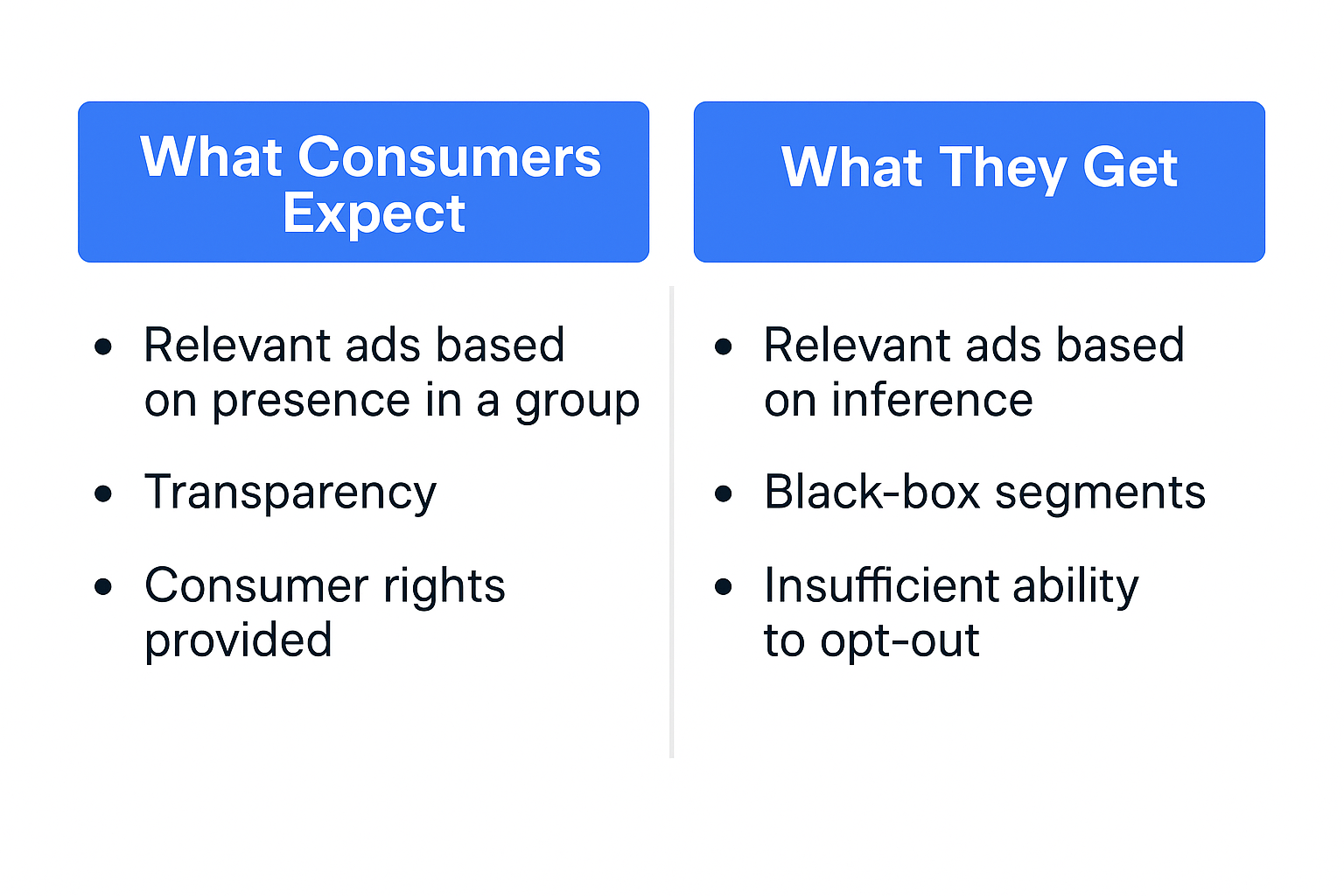
Because when it comes to sensitive topics like health, most people don't expect to be targeted based on a prediction of their health conditions. Especially if they haven't given consent.
What People Don't Expect
Let's make this concrete.
Most consumers don't expect to be placed in segments like:
- "Likely depressed"
- "Trying to get pregnant"
- "Propensity to have diabetes"
These segments are often built using behavioral signals — browsing history, app use, location data — and inferred health traits.
Under the new legal framework, that's a problem. Because what feels like a clever insight may look like a privacy violation to a regulator.
NAI Guidance Reinforces the Point
The Network Advertising Initiative (NAI) — a key self-regulatory body in digital advertising — now advises advertisers to avoid creating or targeting based on inferences about sensitive health conditions.
That's a major shift. For years, the industry leaned on inferences as a workaround. But the new guidance aligns with what state laws are making clear:
If someone wouldn't reasonably expect it, it's probably not compliant.
So What Now?
It's time for a new playbook.
One that doesn't rely on predictions or probabilistic segments. One that puts transparency first. And one that respects what consumers reasonably expect — not just what's technically allowed.
At Blueprint, we're building audience targeting solutions that align with these new standards. And we believe that's where the industry is headed.
If you work in health media, it's time to ask hard questions about how your audiences are built — and whether they'd pass the expectation test.
Want to learn more about how Blueprint builds segments without inferences?
Let's Talk
Ready to discuss audience targeting that meets the new legal standards?
Share this article: